Buying guide13 min read
How to Buy the Perfect Festive Dress for Your Little Girl
A practical buying guide for parents: how to take the four measurements that matter, read a fabric description honestly, spot the comfort faults that end an evening early, judge a listing you cannot touch, set a sensible budget, and order in time for the date.
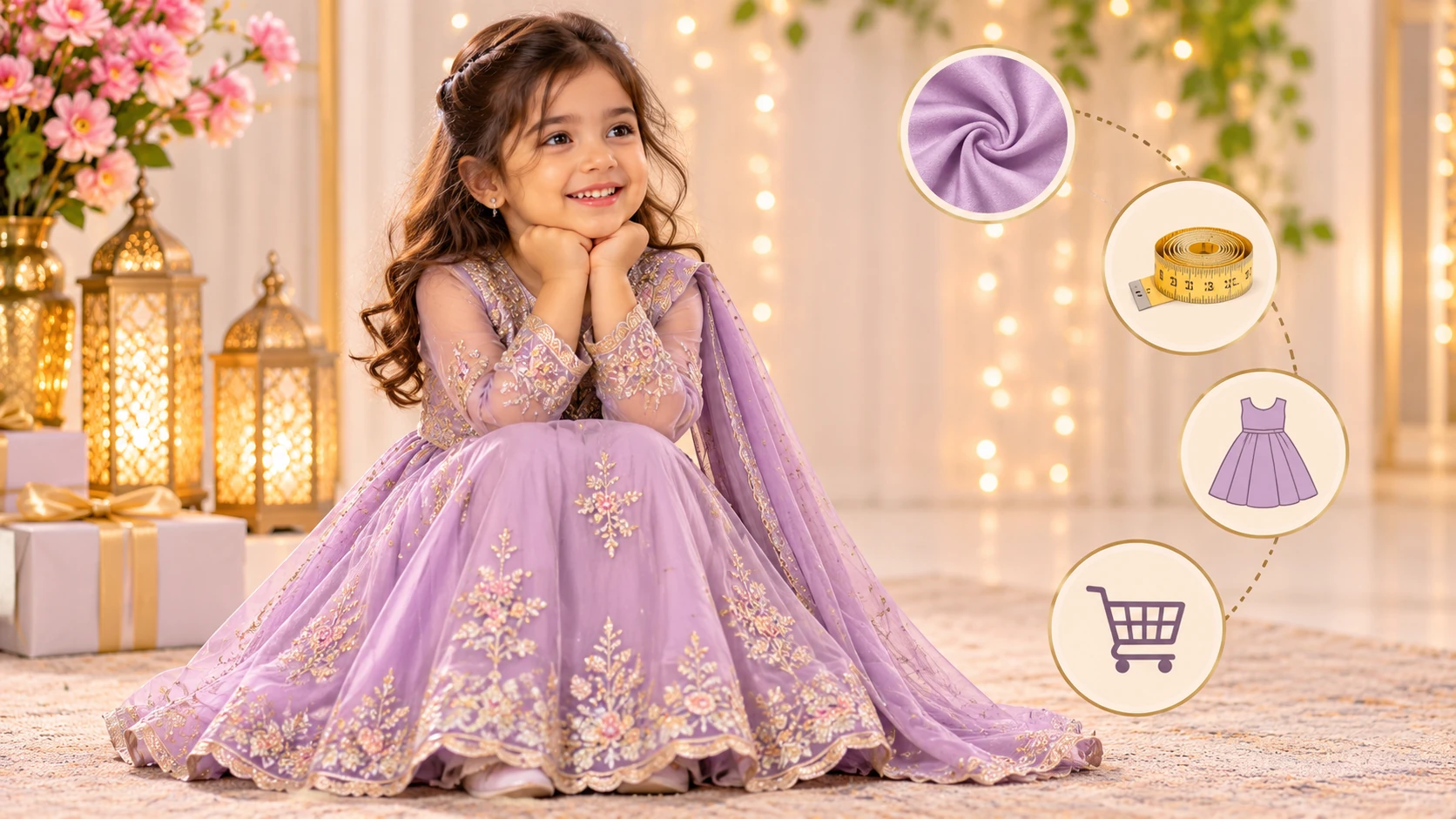
Buying a festive dress for a child is not the same problem as buying one for yourself. You are choosing for someone who is still growing, who will not tell you that the neckline itches until you are already at the function, and who has to last six hours in whatever you picked. The dress that photographs best is not always the dress that survives the evening.
This guide is the process we would follow ourselves, in the order we would follow it. Measurements before browsing, fabric before embellishment, comfort before colour, and the date on the calendar before any of it. Get those four right and the dress almost chooses itself.
Start with the day, not the dress
The most expensive mistake is a beautiful outfit bought for the wrong kind of day. Before looking at a single photograph, write down what the day actually involves: the time it starts, whether it is indoors or out, how long she will be in the outfit, how much of that time she will be sitting, and how much she will be running around with cousins.
A daytime Eid lunch, a Mehndi that runs past midnight and a seated Walima dinner are three different briefs, and the same dress rarely answers all three well. A heavily worked full-length gown is right for the dinner and wrong for the Mehndi. A light lawn kurta is right for the Eid morning and underdressed for the Barat.
- Indoors in the evening: formal fabrics and jewel tones work hardest here.
- Outdoors in daylight: pastels and ivories photograph best; dark heavy fabric gets hot.
- A long night with dancing: choose the lighter, shorter option every time.
- A short daytime event: do not over-dress her. Simple reads better in daylight.
The two-bar test
Adults judge formal wear on how it looks. A child's festive dress has to clear two bars, not one: it has to look like an occasion, and it has to be wearable for the length of one. Nearly every outfit described to us afterwards as a disappointment passed the first bar and failed the second.
It was scratchy at the neck. It was tight across the chest by the second hour. The hem caught on a staircase. The embroidery was so heavy she asked to change before the food came out. None of that is visible in a product photograph, which is why the rest of this guide is mostly about the second bar.
Take four measurements before you shop
Ordering by age is the single most common sizing mistake, and it is easy to see why: age is the number you have. The trouble is that two seven-year-olds can differ by four inches in height and two inches around the chest, and a size chart built on averages cannot know which one you have.
Take these four measurements once, write them in your phone, and you can shop anywhere with confidence. Use a soft tape, stand her upright and barefoot, and keep the tape snug without pulling it tight.
Chest
Around the fullest part of the chest, with her arms down and relaxed. This is the measurement that decides the bodice, and the one that most often forces a size up on a child with a broader frame.
Shoulder to floor
From the top of the shoulder straight down to the floor, barefoot. This decides the length of any full-length frock, maxi or gown, and it matters more than the chest does on those shapes.
Shoulder to knee
The same line, stopped at the knee. This is the number for a shorter frock, a kurta or a peplum shirt, and it is the one people most often forget to take.
Waist and sleeve
Around the natural waist for shalwars, shararas and lehengas, and from the shoulder point to the wrist for sleeve length. On an Anarkali or a maxi, where the flare starts above the waist, the waist measurement barely matters.
- Measure in the evening rather than first thing; children stand differently when tired.
- Measure over a thin vest, not over a jumper.
- Write the date next to the numbers. Anything older than three months is a guess.
- If she falls between two sizes, size up. A slightly loose festive dress can be taken in; a tight one cannot be let out.
Reading a fabric description honestly
Fabric decides how a dress hangs, how warm it is, and how bearable it is after three hours. The names used in listings are not decoration; each one tells you something specific.
Chiffon is light, fluid and the standard for festive wear, especially where a flare needs to open properly. Crush silk carries volume and a crinkled texture without stiff lining, photographs with real depth, and suits winter functions. Plain silk is smoother and heavier, good for a structured frock. Organza is crisp and holds a shape at a hem or sleeve. Net belongs on a yoke or a dupatta rather than against the skin. Lawn and cotton are daytime and summer fabrics, and the right answer for an Eid morning or a school event.
Two words matter more than the fabric name. The first is lined. Any embroidered yoke should say it is lined, because metallic thread against a child's neck is the fastest way to end an evening early. The second is weight. A dress loaded with work is genuinely tiring for a small child to carry around, and beautiful is not the same as heavy.
- Winter evening function: crush silk, silk, or chiffon in a double layer.
- Summer or daytime: single-layer chiffon, lawn, cotton, rib lawn.
- Against the skin: cotton or soft lining, never raw net or sequin backing.
- Hot weather outdoors: avoid heavy silk and anything fully sequinned.
The comfort faults that decide the evening
There are perhaps six things that make a child want a dress off, and all of them are checkable in the first minute after it arrives. Run through them before the day rather than discovering them at the function.
- The neckline: run your hand inside it. Embroidery is lovely outside and rough inside.
- The armholes: she should be able to raise both arms fully without the bodice lifting off her shoulders.
- The waistband: elastic should leave no red mark after ten minutes of wear.
- Fastenings: a zip or button row down the centre back is uncomfortable to sit against for hours. Check how it sits when she leans back in a chair.
- The hem: on a full-length dress it should clear the floor by about half an inch in the shoes she will actually wear.
- The dupatta: a necklace-style drape that stays in place beats a loose length she will drag all evening.
How much embellishment is enough
The instinct at a wedding is to buy the most worked dress in the price range. On a child it is usually the wrong instinct, because embellishment adds weight, scratch and cost in that order, and past a certain point it stops adding beauty.
The dresses that look expensive concentrate their work where the eye lands: a defined yoke, a clear hem border, a worked sleeve edge. Work scattered evenly across the whole body reads as busy in person and as a print in photographs. Gota is the kindest of the traditional embellishments on a child, because it gives festive shine with almost no weight. Tilla has a soft metallic glow and sits best on a bodice. Sitara and sequins catch hard light beautifully in small quantities and snag in large ones.
- Structured work on the yoke, hem and sleeve: good sign.
- Heavy beading across the full skirt: heavy to wear and easy to catch.
- Gota and gota patti: the most comfortable festive finish for a child.
- One embellished element, not three. A worked yoke needs no necklace.
Colour, and the photographs you will keep
The photographs outlast the function, and halls are lit unkindly: warm, yellow, and brighter in some corners than others. A shade that looked perfect in daylight can disappear in the pictures.
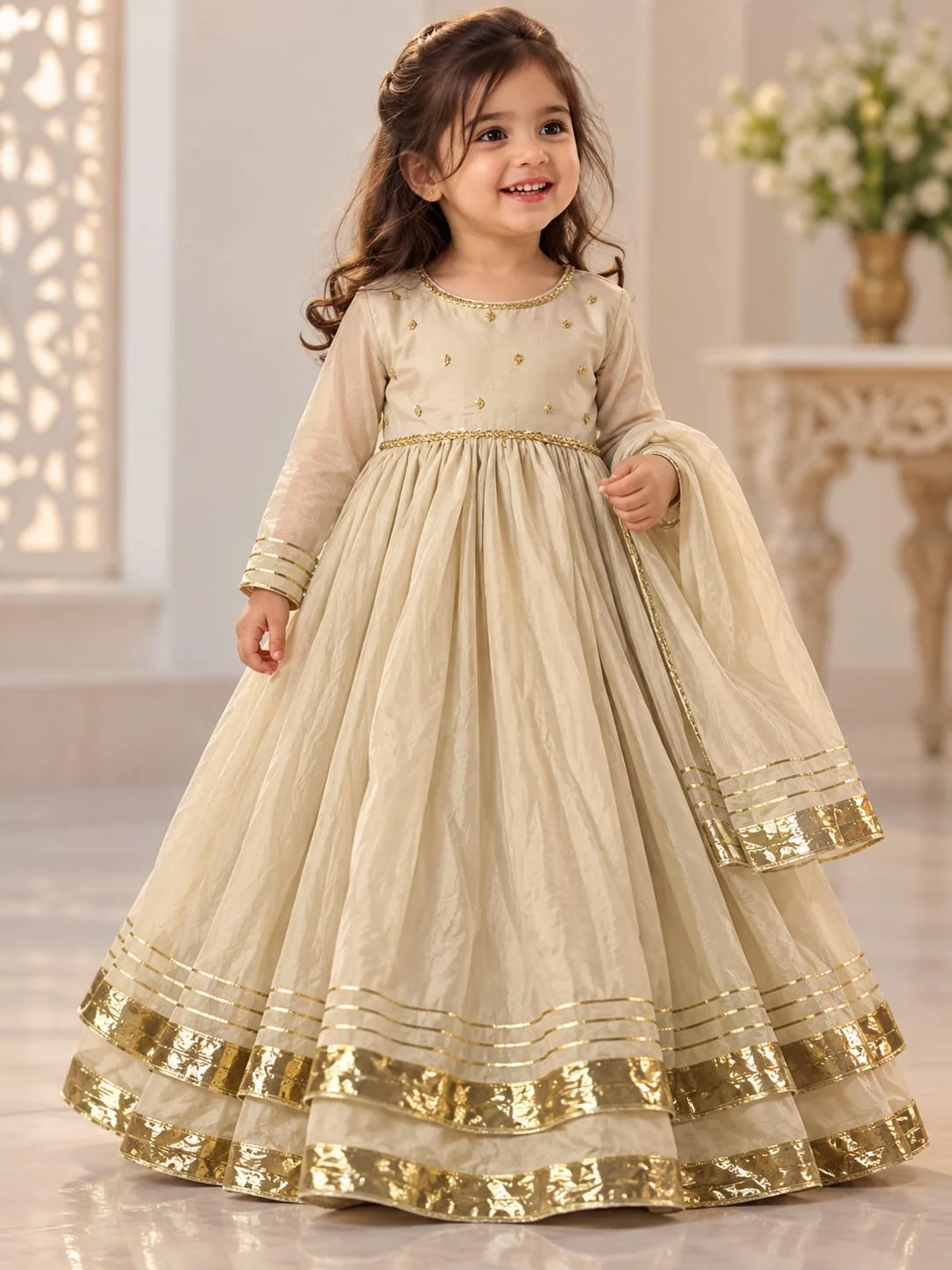
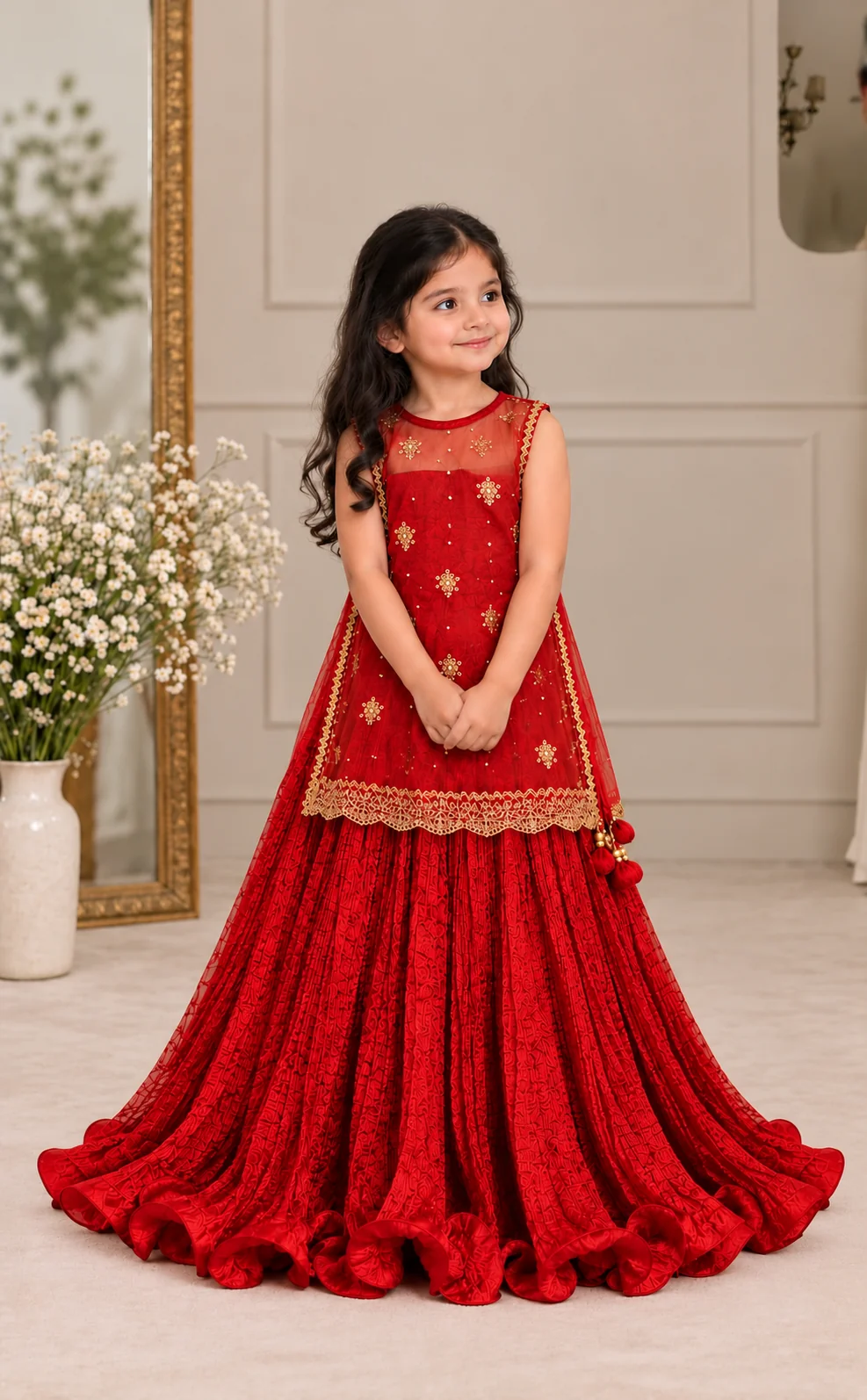
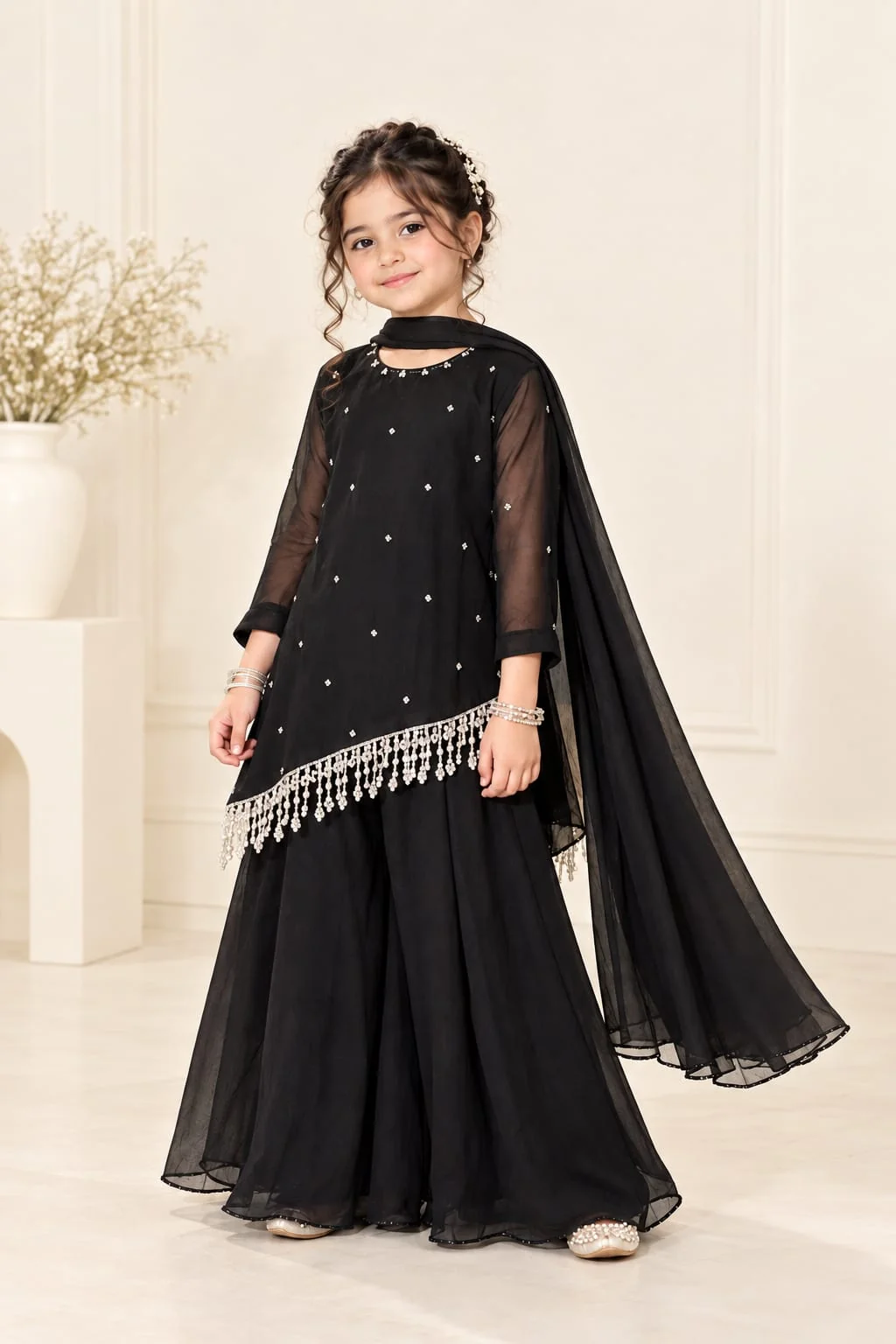
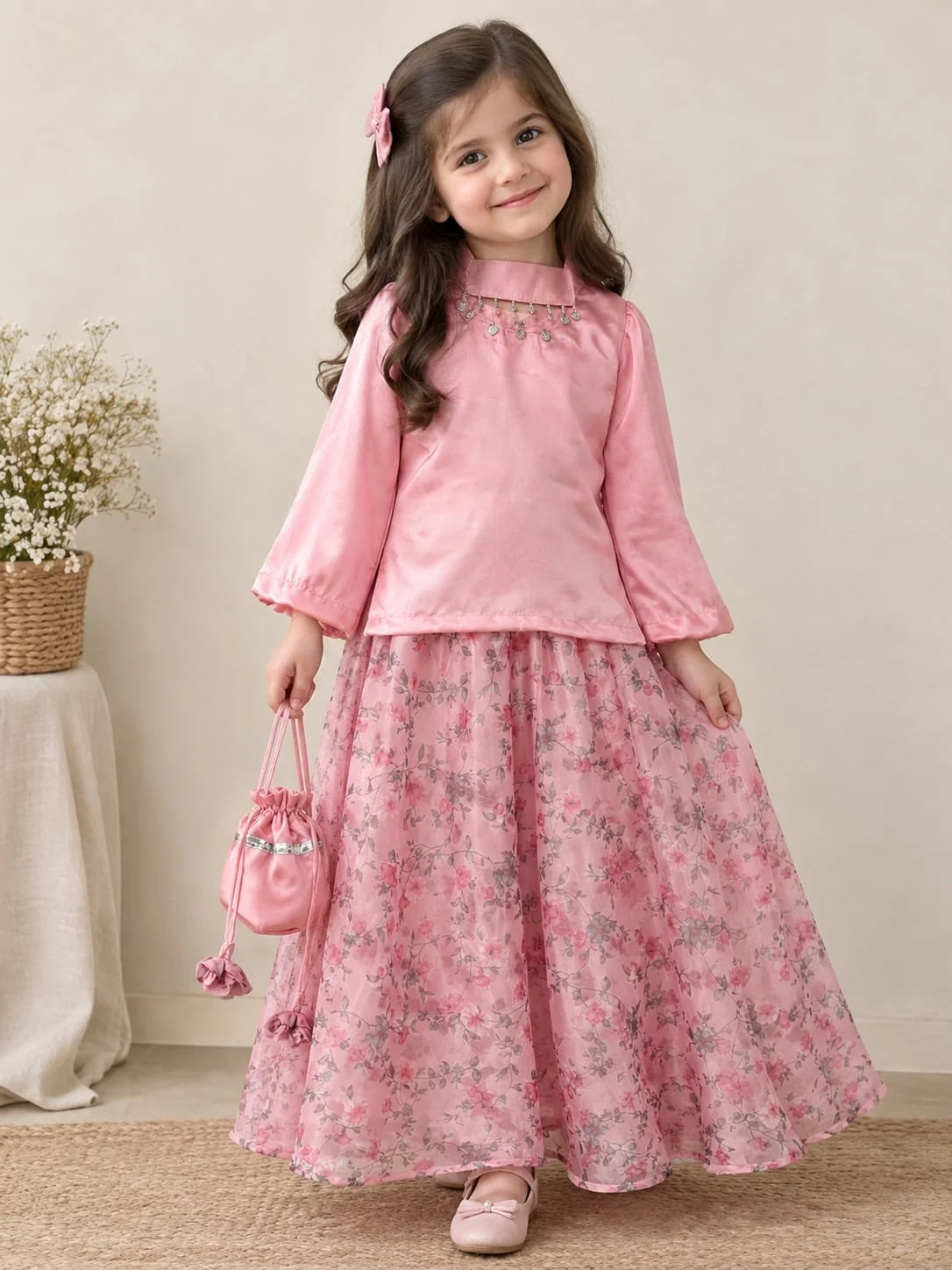
Jewel tones hold their depth under strong indoor lighting. Maroon, emerald, royal blue, magenta and black all keep their embroidery legible in evening photographs. Ivory, beige and champagne are the right register for a Walima or any softly lit event, and they let gota work read clearly rather than competing with it. Pastels are at their best in daylight and can wash out under heavy yellow lighting.
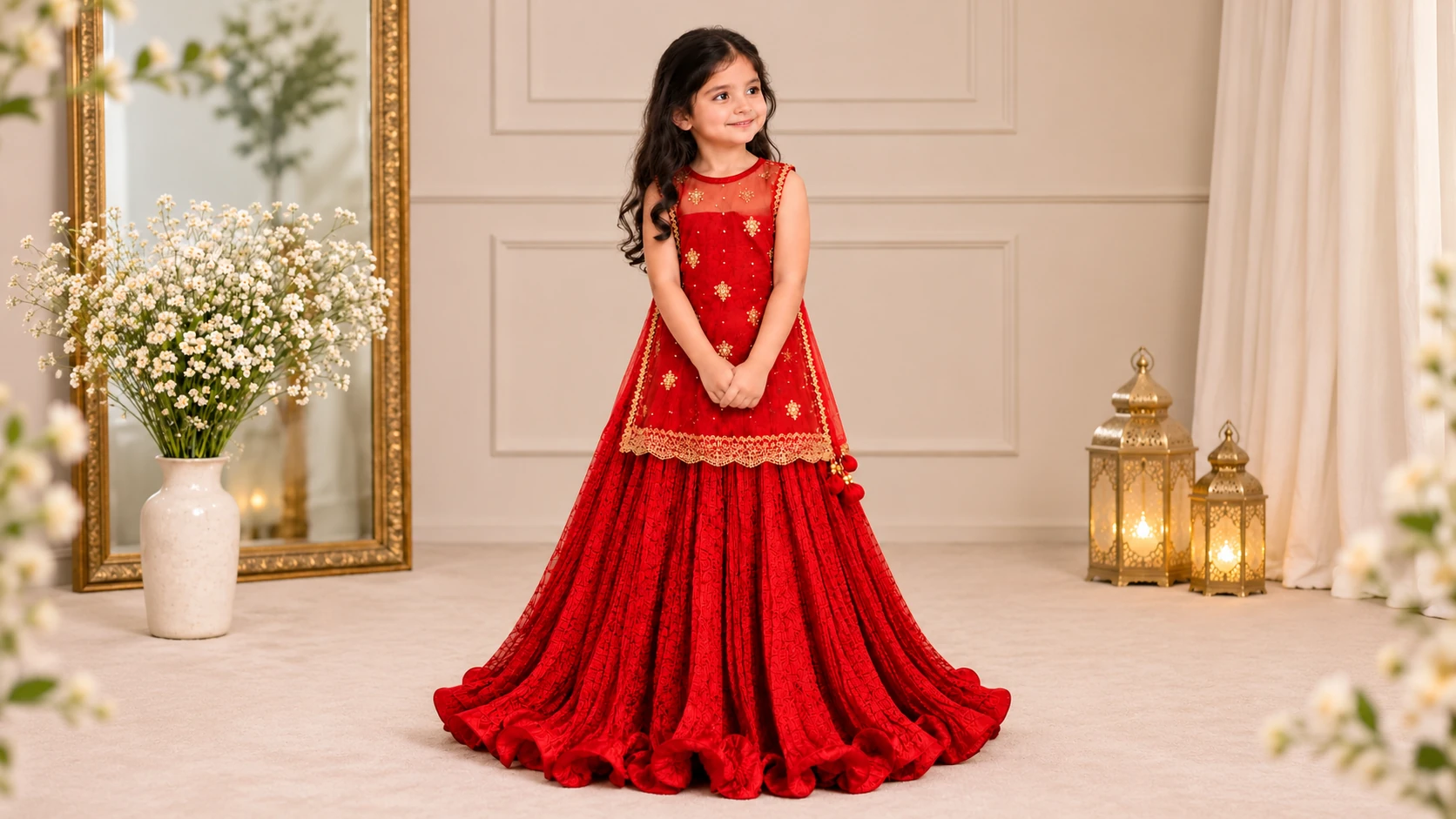
There is one rule beyond that, and it is about manners rather than colour theory: at a Barat, leave deep bridal red and heavy bridal gold alone. Maroon gives you the same richness without stepping on the bride's day.
- Evening and Barat: maroon, emerald, royal blue, magenta, black.
- Walima, Nikah and daytime: ivory, beige, champagne, blush, lavender, sage.
- Eid: ivory with gota, or a soft pastel with hand embroidery.
- Take a test photograph on your phone indoors before the day. A hall is a harsh judge.
Buying online without regret
Most festive shopping now happens from a photograph, which means judging construction from an image and a paragraph of text. It is harder than touching the fabric, but a good listing gives you more than people realise.
Look at how the flare falls in the photograph. A well-cut frock drapes in soft vertical folds; a poorly cut one stands away from the body in a stiff cone, which usually means the volume is coming from lining rather than fabric. Check that the listing names the fabric specifically rather than saying festive material. Check that the dupatta is described as part of the set and what it is made of. Check whether lining is mentioned at all.
Per-size pricing is a quiet but reliable signal. A single price for every age usually means a ready-made run in standard sizes. A price that climbs with the size means the piece is cut to that size, with more fabric and more work in the larger ones, which is what you want for a festive dress that has to fit properly.
- The fabric named specifically, not described vaguely.
- Lining stated for any embroidered neckline.
- The dupatta included and described.
- A real size chart in inches, not only ages.
- Per-size pricing, which tells you it is cut to size.
- A way to ask a question and get an answer the same day.
Where the money shows, and where it does not
A festive dress can cost anything, and the price differences are not evenly distributed between things you will notice and things you will not. It is worth knowing which is which before deciding what to spend.
Money shows in the cut, the fabric weight and the finishing: a flare with enough fabric to move properly, a lined yoke, neat seams inside, a dupatta that matches rather than approximates. Money shows much less in the sheer quantity of embellishment, which is the easiest thing to add and the first thing to look cheap when it is done quickly.
One more thing worth budgeting for honestly: she will grow. A festive dress bought for a wedding in March will not fit for a wedding the following March. Spending at the top of your range on a piece she wears twice makes sense only if it is good enough to hand down to a younger sister, which depends as much on how you store it as on what you paid.
- Worth paying for: fabric quality, a proper flare, lining, neat inside seams.
- Worth paying for: a dupatta that genuinely matches the outfit.
- Not worth paying for: embellishment quantity for its own sake.
- Not worth paying for: a size up as insurance. Order her size and keep the fit.
Ordering in time for the date
The most avoidable disappointment in festive shopping is a dress that arrives after the function. Work backwards from the date rather than forwards from the day you start looking.
Anything cut and stitched to order needs stitching time before a courier is even involved; for our pieces that is 3 to 5 working days. Add delivery, add the possibility that something needs a small adjustment, and add the fact that every maker in the country is busiest in the two weeks before Eid and through wedding season.
So: order two to three weeks ahead of a date you already know, and tell the maker the date when you order. A good one will tell you honestly whether they can meet it instead of hoping.
- Two to three weeks ahead for a fixed date. Four in the fortnight before Eid.
- State the function date in your order or message.
- Confirm courier timelines to your city, not just the stitching time.
- Try the dress on the day it arrives, not the night before the function.
The ten-minute rehearsal before the day
Put the whole outfit on her a few days before: dress, dupatta, shoes, and whatever is going in her hair. Ten minutes of this is worth more than any amount of looking at it on a hanger.
Have her sit on the floor, climb a few stairs, raise both arms and spin once. Watch whether the dupatta stays put, whether the hem catches, whether she starts pulling at the neckline. Anything you find now is fixable with a pin, a stitch or a different pair of shoes. The same discovery at the function is not.
Making it last long enough to hand down
The festive dresses that reach a younger sister in good condition are simply the ones that were put away properly. The ones that do not were put away dirty.
Perfume, food marks and invisible residue oxidise over months into permanent yellow patches, so deal with the dress within a week of the function rather than at the start of the next season. Anything in silk or chiffon with metallic work should be dry cleaned rather than washed at home. Steam on the lowest setting to lift creases, because a hot iron flattens gota and crush texture permanently. Store it folded in tissue rather than on a hanger, so the weight of the embroidery does not pull the fabric out of shape over a year in a cupboard.
The short version
If you remember nothing else from this guide, these are the decisions that actually determine whether the dress was the right one.
- Write down what the day involves before looking at any dress.
- Take chest, shoulder-to-floor, shoulder-to-knee and waist, and shop by those, never by age.
- Match fabric to the season and check the word lined in the description.
- Choose structured embellishment over scattered embellishment.
- Pick a colour for the lighting she will be photographed in.
- Order two to three weeks ahead and state the date.
- Rehearse the full outfit at home, shoes included.
- Clean and fold it away within a week afterwards.